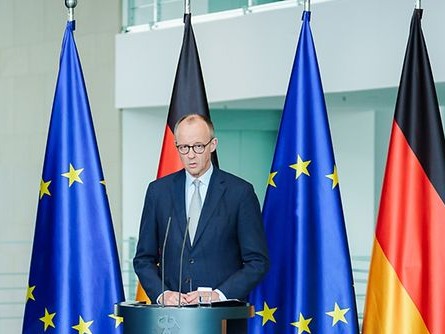
Lost in Transformation: While Merz demands European sovereignty in speeches, he defaults to alignment with the US when it counts. Negating international law undermines an alliance of middle powers against aggressive great-power politics. It endangers Germany’s security. In Wadephul’s and Pistorius’s applause for Marco Rubio’s rejection of European sovereignty, the geostrategic failure of the black-red government is laid bare.
Friedrich Merz opened the Munich Security Conference with a remarkable speech. He explicitly committed to strengthening Europe’s sovereignty, building on the idea put forward by Canadian Prime Minister Mark Carney in Davos: in a world where great powers increasingly impose their interests by force, middle powers must work together. The foundation of that cooperation is international law and economic collaboration.
The conclusion of the Mercosur agreement fits with the Chancellor’s speech. The cooperation signals during Merz’s visit to China sent a clear message toward Trump’s America. Yet as so often with Merz: what he gets right at the front, he tears down at the back.
Unlike Spain, Germany did not condemn the US-Israeli attack on Iran. On the contrary — together with Macron and Starmer, Merz called only on Iran to halt its counterattacks, warning that otherwise the three countries would “enable” military operations against Iran. In other words, Germany is threatening Iran with military strikes — to the delight of Republican Senator Lindsey Graham.
A pattern is emerging here. The speeches about European strength and sovereignty are Sunday sermons. When it comes to the crunch, Merz falls in line with Trump. This was already the case during the last US-Israeli attack on Iran, when Merz praised the action as being in compliance with international law, saying that the US and Israel were doing the “dirty work” for us. The attack on Venezuela was, to Merz, too “complex” to assess under international law. His willingness today to enable attacks that violate both international and constitutional law suggests he is operating with less nuance than ever. Unlike the Spanish US bases at Rota and Morón, Germany’s Ramstein Air Base continues to be available for strikes against Iran.
International Law
Openly positioning oneself against international law cuts against Germany’s most basic security interests. The UN Charter permits the use of force only to repel an imminent armed attack — a threat that even US intelligence agencies deny exists. The prohibition on the use of force therefore applies. No one sheds tears for Khamenei and his generals. But their killing is not sanctioned by international law.
Even less justifiable are Trump’s and Netanyahu’s motives for this war. Setting Netanyahu aside: Trump has never cast himself as a champion of democracy and freedom. He is taking a wrecking ball to democracy within the United States itself. As with Venezuela, Trump could likely live with a Revolutionary Guards dictatorship, as long as it submits to his geopolitical vision — while Reza Pahlavi continues playing the role of exile figurehead and sits alongside María Corina Machado outside the gates of Mar-a-Lago.
The reference to Iran’s nuclear program also fails as a justification for war. Iran’s nuclear program was better controlled under the deal — before Trump withdrew from it in 2017 — than it is today, after two US strikes. Trump put himself and the world at greater risk by abandoning that agreement. Reducing that risk would require cooperation with China, the kind of cooperation that once effectively contained Iran.
But cooperation with China on Iran conflicts with another US interest: global control over oil and gas prices. China is the largest buyer of Iranian oil, at prices below the world market rate. Trump wants to keep the world locked into fossil fuel dependency and preserve American energy dominance. Cutting China off from cheap Iranian oil serves his interests.
International law is not a moral nicety. It protects precisely those who cannot enforce their rights through force — middle powers like Germany, as well as Europe, Canada, and Brazil. The majority of the world’s nations depend on this legal framework. That is why these countries must work together.
Failure
Merz and Wadephul, Klingbeil and Pistorius know all of this. They say as much in their speeches. But they do not act accordingly.
How can Germany forge strategic alliances with Latin America while failing to condemn the violent enforcement of the “Donroe Doctrine” against Venezuela — while not defending the sovereignty of Latin American states against the United States? How can Germany win allies for solidarity with Ukraine while justifying Trump’s and Netanyahu’s rationale for war in Iran? How can Germany defend European sovereignty while simultaneously deepening its dependence on US liquefied natural gas instead of accelerating domestic renewables?
The federal government appears strangely disoriented in this era of global upheaval. The day after Merz spoke at the Munich Security Conference, the architect of the US National Security Strategy took the stage. Marco Rubio flatly rejected Merz’s vision of greater European sovereignty: he wants a strong Europe, but not a sovereign one. In response, Johann Wadephul and Boris Pistorius were the first to rise to their feet in a standing ovation.
In the Iran war, Germany’s geostrategic failure under the black-red coalition stands fully exposed.