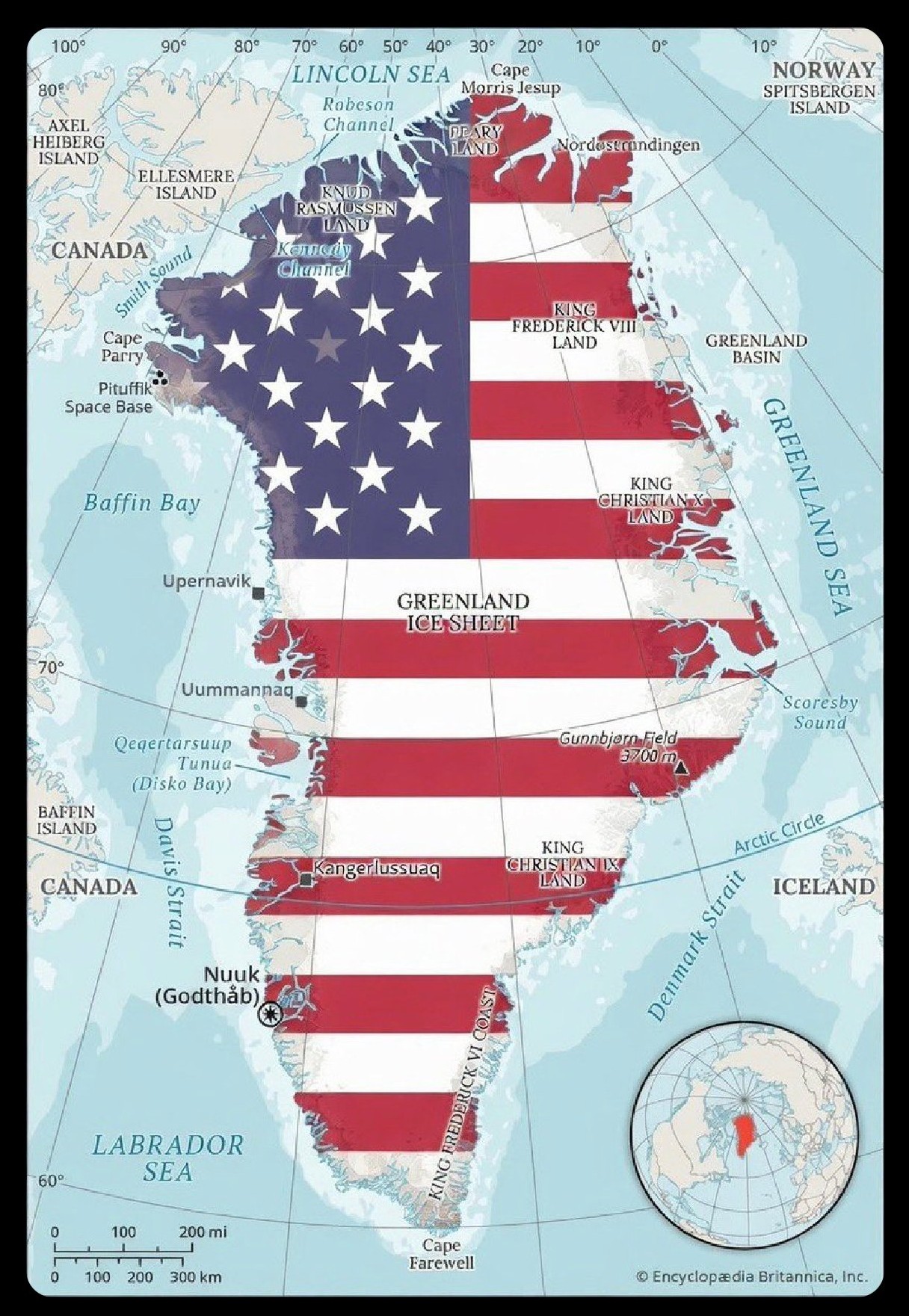
From the Caribbean to the Arctic
Imperialism has returned to the United States.
First in the Caribbean, now in the Arctic. And it’s about more than Greenland – it’s about Europe’s sovereignty.
These are my theses for the podcast with Jochen Bittner hosted by Paul Ronzheimer.
- The attack on Venezuela and the abduction of Maduro violate international law. It is an assault on a sovereign state without any imminent armed attack that had to be repelled.
- The U.S. strike has not removed Venezuela’s brutal and corrupt regime. Trump wants to cooperate with Maduro’s apparatus of repression in the army and police. It’s not about regime change—it’s about an “oil change,” as taz aptly headlined.
- The attack aims to expand and secure U.S. spheres of influence in Latin America. There is a historical precedent for this: it’s called imperialism.
- The idea of limited sovereignty for states within great power spheres is something Trump shares with Putin and Xi. What he practices in Venezuela and announces for Greenland, Putin carries out in Ukraine and Georgia. Xi treats Vietnam and the Philippines in the South China Sea the same way.
- International law is no trifling matter. It arose from the experiences of two world wars that left over 60 million dead. A rules-based order under the umbrella of the United Nations was meant to prevent that. Adhering to international law is not a “nice to have”; it is in the vital interest of small and medium-sized states in particular. It is in Europe’s interest.
- International law has always had a weakness: there is no place to enforce it. The world has no court of law. Those who decide on international law in the UN Security Council have granted themselves an exemption through their veto power.
- A rules-based global order served U.S. interests as long as the country’s economic, political, and military power could sustain it. This era ended with the failures in Iraq and Afghanistan and with China’s rise. The United States is no longer a global ordering power.
- Trump accepts this failure. His response is a return to unilateral great-power politics. Instead of a global order, he pursues the consolidation and expansion of U.S. zones of influence. He means it seriously—in Greenland, in Colombia, in Mexico, in Canada.
- Trump does not want to protect Europe; he wants to control it. Trump’s National Security Strategy seeks to prevent anyone else from dominating Europe. That is not a reassuring message—it’s a declaration of confrontation. Only the United States, in Trump’s view, should dominate Europe. European sovereignty has no place in his plans.
- To secure U.S. hegemony in Europe, the European Union must be dismantled. Trump sees the EU as an adversary, “founded to cheat the U.S.” Therefore, the United States intends to sponsor and strengthen anti-democratic and anti-European parties across Europe.
- Merz, von der Leyen, and Kallas have failed to defend Europe’s vital interests. They practice submissiveness toward Trump, believing they can contain him through appeasement. That already failed with their capitulation to his tariffs—to the detriment of Europe’s economy.
- Europe faces an existential challenge. The EU must finally recognize that Trump only responds to pushback. The annexation of Greenland must come with a price tag—politically, economically, and yes, militarily. It will be uncomfortable. Europe is not in a strong position, but with its half-billion citizens and economic power, it is far from weak. The appeasement of the autocrat Trump must end.