The Violent End of the Fossil Age
Fossile verlieren das Rennen gegen Erneuerbare, Verbrennung verliert gegen Elektrifizierung weltweit. Was das für eine neue geostrategische Lage bedeutet, darüber habe ich am 18. Mai 2026 beim diesjährigen Berlin Forum on Global Cooperation der Heinrich-Böll-Stiftung gesprochen:
Dear Imme, dear Biqing, dear Qing
dear Jörg, dear Markus, dear Adam,
Dear friends,
Ladies and gentlemen!
Thank yo for the invitation. Let’s talk about geostrategy.
1 We are experiencing a threefold trend reversal.
Today, three long-term developments are coming to an end and a new reality is challenging us.
1.1 There is no longer a global hegemon.
For over 80 years, the world was first characterised by two hegemons, then one. The fall of the Berlin Wall 35 years ago marked the end of the old hegemon, the Soviet Union. But it was also the beginning of the end of the other hegemon, the USA. The wars in Iraq, Afghanistan and Libya revealed its overextension. Today, the USA can no longer organise a global order. Under Trump, they no longer want to. The costs are too high. Trump only wants to lead the strongest gang in a world under the law of the jungle. The rise of China, which has gone hand in hand with the political and economic decline of the USA, is causing it to strive for hegemony. However, the world is still a multipolar one – in which Europe must rediscover its role.
1.2 Democratic capitalism is no longer a global model.
Combining prosperity and freedom – that is what democratic capitalism stood for 80 years. It was not only in the North. Latin America and South Africa fought for their democratic freedom against Europe and the USA. The model of democratic capitalism is eroding. Fascist and autocratic forces are spreading in its core countries. Globally, democratic capitalism is coming under pressure from China. China’s authoritarian state capitalism is seen by many societies as the more effective development model.
1.3 Fossil capitalism is coming to an end.
Two hundred years of industrialisation were inextricably linked to the use of coal, oil and gas. The promise of prosperity of democratic capitalism was linked to fossil fuels. Geopolitical power grew out of the possession and availability of fossil fuels and their prices. This is changing dramatically. On the one hand, the climate crisis resulting from fossil fuels is now massively undermining the promise of prosperity. On the other hand, the global boom in renewables proves that value creation and growth are no longer dependent on coal, oil and gas. The vulnerability of fossil capitalism to crises is currently most evident in the Strait of Hormuz.
2 There is a new global polarisation – petro vs. electro states.
The multipolar world is struggling to find a new order. The old contrasts between rich and poor, between democracy and autocracy remain. However, they are increasingly determined by a new polarisation: The polarisation between petro and electro states, between states producing an exporting fossil fuels and nations, that start to rely on electro technologies. The old petro states such as Russia, the USA and the Gulf States are confronted with states that are focussing on the electrification of industry, households and transport instead of combustion technologies. Electro states as an model of develpoment, decarbonised industral societies pose an existential threat to the global power of the petrostates. For China, the only question is when it will free itself from its dependence on fossil fuels, not if. China is now closer to Europe in this respect than the USA and Russia.
2.1 Fossil fuels are losing the race.
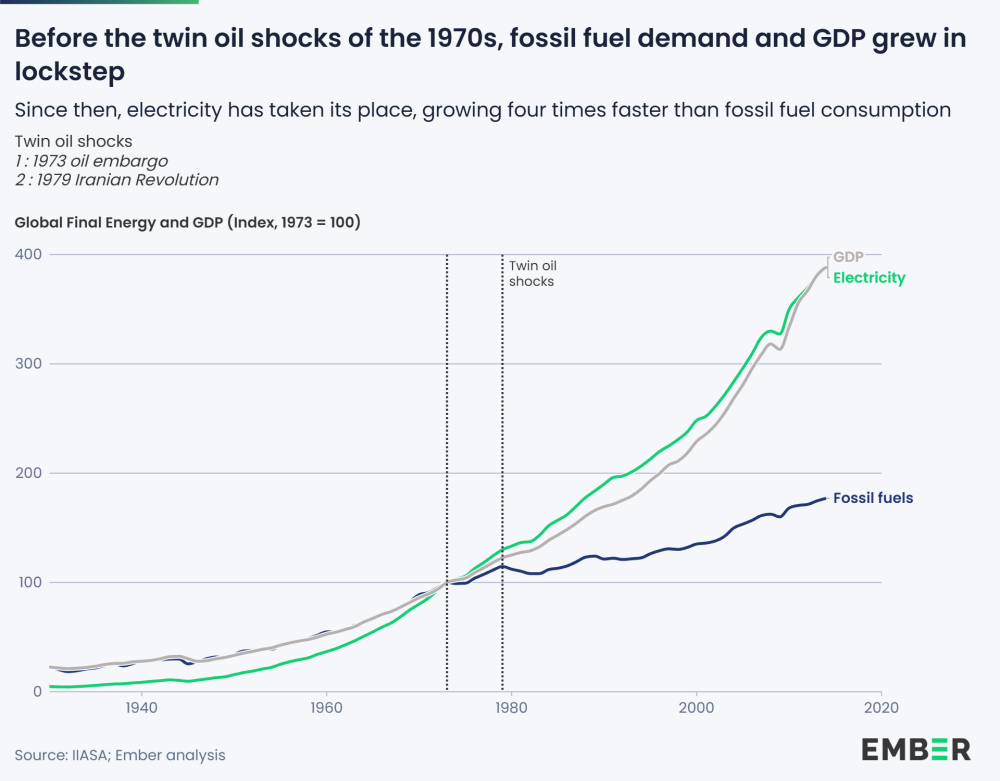
Without repeating Biqing’s figures from Ember here. It is obvious that fossil fuels are losing the race with renewables. Renewables are cheaper and, as predominantly domestic energies, safer and more reliable. This applies not only to direct electricity generation, including system costs. In China today, a good third of all energy used is renewable. Driven by its EVs, China has become the world’s largest car exporter in five years. It has overtaken the USA, Japan and Germany.
2.2 The loss of fossil power is fuelling an imperialism of weakness.
Both Russia and the USA have realised that they cannot win the economic race with renewables. For Russia, the ability to export fossil fuels is indispensable for the survival of Putin’s power. The USA sees its role as a global price regulator for oil and gas being called into question. “Energy dominance” is therefore a strategic goal at the centre of the current US security strategy. Trump openly states that he is interested in the natural resources in Greenland, Venezuela and Iran. Both the USA and Russia are responding to their economic weakness with authoritarianism at home and aggression abroad. Imperialism out of economic weakness is the fossil powers’ violent response to their loss of competitiveness.
2.3 The Iran war is the fossil Fukushima.
With the attack on Iran, Trump has triggered a global energy crisis of historic dimensions. The IEA estimates its impact to be more significant than the crises of 1973 and 1979 combined. The crisis is hitting Asia and poorer countries in the Global South particularly hard. US oil and gas companies are making massive excess profits. Nevertheless, the USA and Trump may well become the losers of this crisis. The fuel bills of voters in the USA are rising with global oil prices.
What’s more, Trump’s battle for energy dominance may backfire spectacularly. More and more countries want to free themselves from fossil fuel dependency. For them, the Iran war is the fossil Fukushima. They are focussing on the expansion of renewable energies and accelerated electrification. Unfortunately, under its current government Germany is bucking the trend and focuses on extending the era of combustion engines and gas heating systems.
3 Petro vs. electro states polarise in a multipolar world.
The geostrategic question is: How can the rule of law safeguarded a multipolar world? Petro vs. electro states does not describe a new bloc confrontation. The world will not simply become bipolar again. A bloc requires homogeneous common interests and a common vision as well as a hegemon. We find none of this in either the petrostates or the electro states.
3.1 The new order of the world is characterised less by the struggle between democracy and autocracy than by the polarisation between petro states and electro states.
The USA has proven in its attacks on Venezuela and Iran that it is not interested in democracy. Russia has declared its war of aggression against democracy in Ukraine. Democracy and a market economy are the better prerequisites for the ramp-up of renewables. Monopolies and corruption are blocking them. However, the biggest investor in renewables and electrification, China, is an authoritarian state capitalism.
3.2 The polarisation between petro and electro states affects countries in both the North and the Global South.
As much as many countries in the Global South are suffering from the consequences of the Iran war and their dependence on fossil fuels, there are enough countries in the Global South whose elites continue to rely on the returns and power from fossil fuels. India, on the other hand, has decided not to take the fossil fuel diversions in the first place. Access to homegrown renewable energy strengthens states of the Global South. Highly developed industrialised countries such as Japan, South Korea and Europe, on the other hand, have a massive interest in freeing themselves from their dependence on fossil fuels. They have to assert this against an old ally from whose military protection they have benefited a long time.
3.3 Cooperation among electro states is more similar to the BRICS model than to a new bloc.
Energy cooperation between countries in the global South and North is the path to a post-fossil future. Examples can be found in Germany’s cooperation with Chile, Namibia and Canada. Pragmatic cooperation is taking place, regardless of differences in other areas. In the multipolar world, such alliances will become the rule.
4 Europe’s sovereignty and competitiveness depend on electricity.
Europe has the choice of becoming an electrostate or remaining dependent on fossil fuels. After the second global energy crisis in five years, it is time to finally choose the more safer, cleaner, cheaper, simply better alternative.
4.1 Climate neutrality creates sovereignty.
If the European sovereignty called for by Merz and Macron is to be realised, Europe’s dependence on energy imports must be drastically reduced. By expanding renewables and accelerating electrification, Europe can become the first climate-neutral continent by 2050. A climate-neutral Europe is a geostrategically more sovereign Europe. That is why Trump wants to prevent this by all means.
4.2 Germany is putting the brakes on Europe.
As in the tariff war, it is Germany in particular that is anxiously blocking a self-confident European course. The commitment to buy US energy – mainly fracking gas – to the tune of 750 billion US Dollar in as part of a trade deal that consists of duty-free tariffs for the US exports to Europe while EU products face 15 to 50 per cent tariffs in the US is not just an attack on Europe’s climate goals. It undermines Europe’s sovereignty. Gas is not a transitional technology, it keeps us dependent. Extending the eraof combustion engines and gas heating systems does not make them more competitive, but keeps energy costs high.
4.3 Resilience costs – sovereignty pays off.
Ending dependence on fossil fuels is necessary, but not sufficient. Key technologies for renewables and electrification must be available in Europe. Those who do not want to be dependent on Trump and Putin must not be technologically dependent on Xi. The mistake of driving the PV industry out of Europe must not be repeated. We need clear local content rules for the wind industry and battery technology, but also a ban on inverters from China. In the event of a crisis, security of supply must be guaranteed in Europe. Even as an electrical state, China remains a partner, competitor and systemic rival. This also applies to other dependencies. They must be ended: No more Outlook, MS Office und Teams in public services, no more public service on US servers. This all costs money – but it is worth it in the event of a crisis.
5 The answer to fossil imperialism: an alliance of the middle powers against the fossil warriors.
The alliance of middle powers proposed by Mark Carney in Davos is not an alliance of electro states. Canada is a fossil fuel exporter. Nevertheless, Carney is right. If we want to counter the law of the jungle, we we have to create and to defend spaces with the rule of law in the multipolar world. That’s the core of the alliance of middle powers.
5.1 Only together can Europe defend itself.
For Trump, Article 5 of the NATO treaty is an instrument of blackmail, to achieve compliance, no longer a pledge of support. Europe must invest in its military security if it does not want to remain vulnerable to blackmail and counter the threat posed by Putin’s imperialism.
5.2 We need spaces for rule-based trade.
This includes strategic alliances with the countries of Asia, Latin America and Africa. The linking of common economic interests facilitates the peaceful resolution of conflicts of interest.
5.3 Electrification and renewables create security and slow down the climate crisis.
This is the answer to the violent end of the fossil age. It’s a strategy of peace, security an independence.
Thank you very much.